2026-10-01
Jellyfish Launches Share of Model™ Shopping Optimization

Jellyfish has launched new Shopping Optimization capabilities within our proprietary Share of Model™ Platform to help marketers analyze AI shopping behavior at the individual product level and understand how different AI systems evaluate, compare and recommend specific SKUs.
It is a fundamentally different lens from the solutions marketers use today. Conventional digital-shelf tracking measures how a brand ranks on a retailer's own website. First-generation AI-visibility tools measure whether a brand is mentioned in a chatbot's answer. Share of Model™ Shopping Optimization measures what determines an agentic purchase: the specific products an AI recommends, where they rank, what they cost, how they're rated – and, uniquely, which retailer the AI would buy them from.
To help brands prepare, Share of Model™ Shopping Optimization enables marketers to:
- Analyze AI visibility at the individual SKU level – not just the brand level
- Understand why specific products are recommended – or overlooked – by AI shopping systems
- Identify the attributes, content signals and information sources influencing AI recommendations
- Compare product performance across leading AI shopping environments
- Prioritize optimization opportunities that improve visibility before consumers ever reach a retailer
- Measure changes in AI product visibility over time and evaluate the impact of optimization efforts
"Until now, marketers have had little visibility into why AI shopping systems favor one product over another. Share of Model's Shopping Optimization gives brands a clear understanding of the factors driving AI recommendations, so they can focus their optimization efforts and measure the business impact.”
Natasha Wallace, Chief Solutions Officer, Jellyfish.
New Research Reveals Shopping Assistants Create Radically Different ‘AI Shelves’
New research from Jellyfish reveals that AI shopping is reshaping competitive dynamics in ways that marketers may not expect – with different AI assistants showcasing dramatically different sets of brands and products for the same purchase, collapsing traditional price tiers, and challenging established brand advantages.
Jellyfish’s Share of Model™ Platform analyzed how AI shopping systems recommend products across eight categories – including fashion, athletic wear, men's suits, home appliances and furniture – in the US, UK, Australia and Singapore, spanning ChatGPT, Google AI Mode and Amazon's Alexa for Shopping.
The findings show that an "AI shelf" diverges significantly from the retail or search landscapes that brands know:
There is no single "AI shelf."
Ask two assistants the same shopping question and you get two different shelf experiences. Across the eight categories, ChatGPT accounted for roughly 80% of AI product recommendations and Google's AI Mode around 20% – a four-to-one gap that ranged from under three-to-one to nearly thirty-to-one (in home appliances, 97% versus 3%).
AI can erase brand leadership.
A single AI shopping question surfaced as many as 290 competing brands. In US fashion, recommendations spanned 120 brands, yet the most-recommended brand held just 7% of the shelf –a category with no leader. Marketers can now see whether AI treats their category as a branded shelf or a commodity scramble.
AI ignores price positioning.
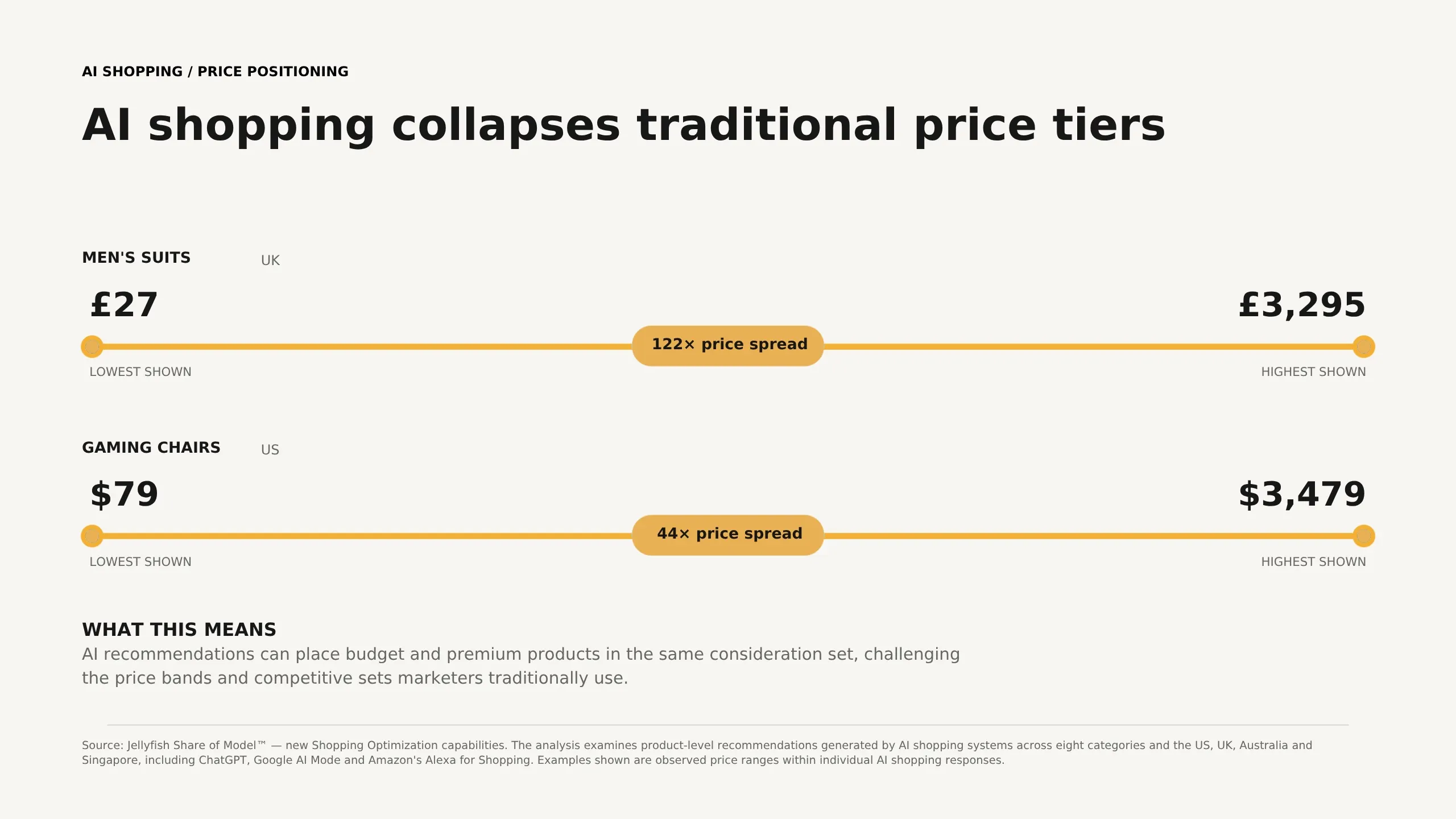
AI shopping recommendations are also bringing in a broader set of products than a brand might typically compete with. In one AI response, the price range of products shown spanned from £27 to £3,295 for men’s suits in the UK; for gaming chairs in the US, $79 to $3,479. A premium product now sits one line below a budget alternative in the same recommendation.
Winning on one assistant tells a brand little about its position on another.
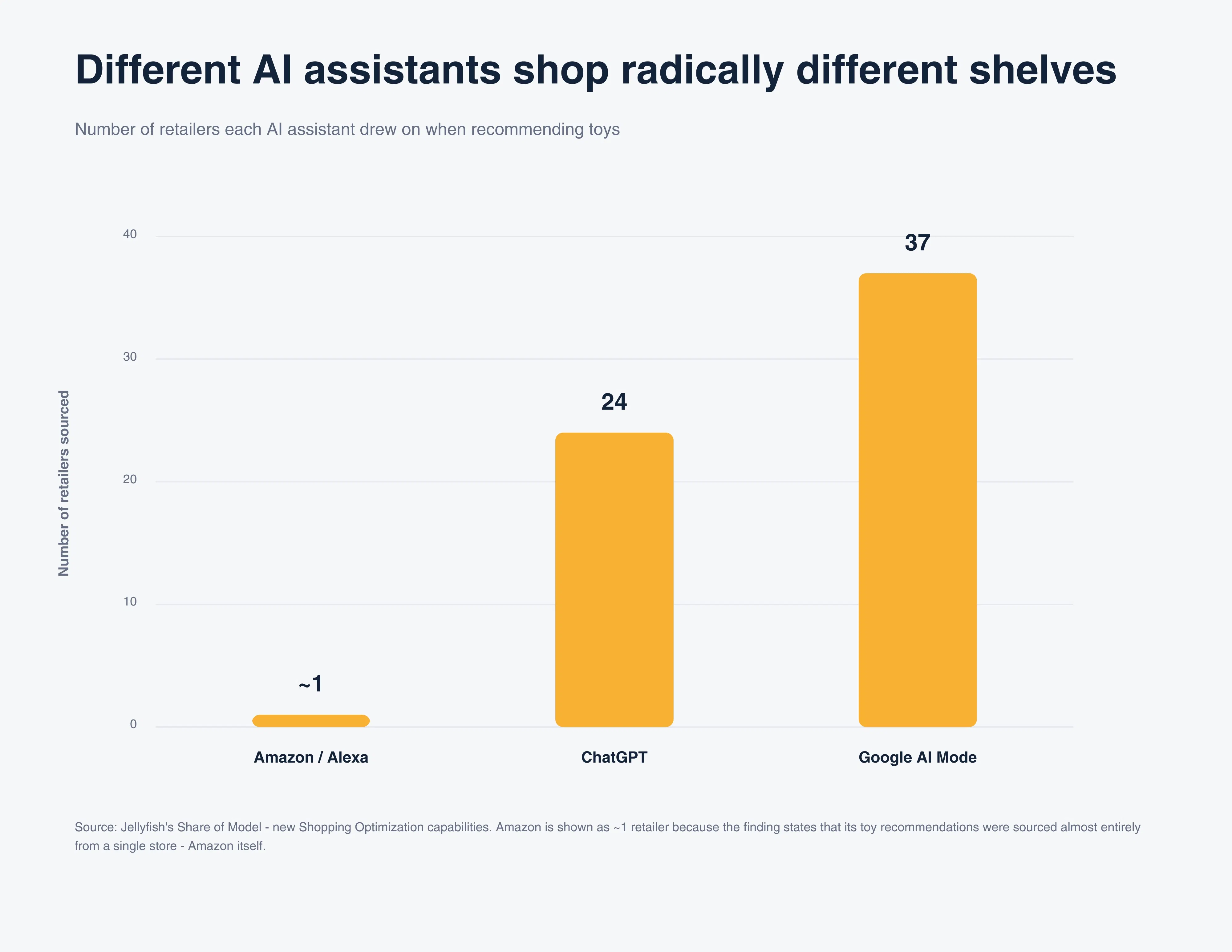
Different assistants "shop" at a radically different number of stores. The number of retailers an assistant drew on before recommending ranged from effectively one to more than 170. Asked for toys, Amazon recommended products from 177 brands but sourced them almost entirely from a single store – itself – while, for the same request, ChatGPT drew on 24 retailers and Google's AI Mode on 37. In US athletic wear, ChatGPT considered 171 retailers and Google's AI Mode 126.
The same request can produce a dramatically different field of choice.
Asked to recommend men's suits in the UK, ChatGPT considered 30 retailers before answering; Google's AI Mode considered four.
These insights were made possible by the new Shopping Optimization functionality, which is now available across all global markets.
"Brands have spent decades optimizing products for search engines, marketplaces and retailer shelves. Agentic commerce changes that equation,” said John Dawson, Vice President, Strategy, Jellyfish. “AI shopping assistants are becoming active participants in purchase decisions, creating a new decision-maker brands must optimize for. Our own data shows the same product question can return a thirty-retailer shortlist on one assistant and a closed, single-store answer on another – so 'winning AI' isn't one race, it's many, and most brands can't yet see the starting line."
Shopping Optimization builds on Jellyfish's broader Share of Model platform, extending its role from measuring AI visibility to enabling a more complete view to support a Generative Engine Marketing (GEM) approach. While Share of Model helps brands measure performance across leading AI systems, Shopping Optimization – alongside its Creator Intelligence and AI Ads Optimization capabilities – helps brands improve product performance across owned, earned and paid AI touchpoints throughout the customer journey.